Know What Doubles Your Risk of Melanoma?
July 22, 2026
“According to the Skin Cancer Foundation, it only takes 5 sunburns to double your risks for developing melanoma skin cancer.”
So, what’s the best strategy to protect your skin during UV Safety Awareness Month? That’s simple, avoid getting burned by applying proven methods of sun protection, especially when UV rays are the strongest and more dangerous. For those residing in Central Florida communities, getting sunburned can happen quickly, and it can be painful causing lasting damage to the skin, particularly at a younger age. At a minimum, overexposure to UV radiation is particularly harmful and more than 33,000 people require emergency medical attention each year.
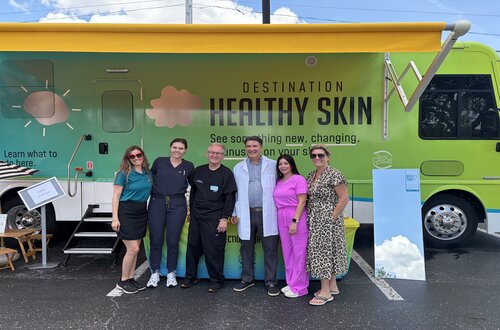
Detecting skin cancers at the earliest stages is at the heart and center of the Skin Cancer Foundation’s Destination Healthy Skin Annual RV Tour that’s fueled by engaged volunteers, local dermatologists and their dedicated staff, as well as individual donors and sponsors. This lifesaving legacy of early detection allow medical providers and educators to directly connect with the community to boost diagnosis and treatment of UV-related skin diseases.
"It is such an important mission to promote early skin cancer detection and UV sun protection,” says Dr. Michael Steppie Orlando Mohs surgeon and medical director of Associates in Dermatology. “Since skin cancer is the #1 type of cancer being diagnosed and treated in the United States today, the Destination Healthy Skin Tour’s role will again be to provide cancer screenings and educational materials when visiting about 40 U.S. cities this year.” Dr. Steppie was again thrilled to participate in this year's event and was accompanied in Orlando by four of his dermatology providers as well as Associate in Dermatology’s marketing director Sandra Helleu.
People of all skin types, tones and colors at this year’s RV Tour could get a skin exam and have their medical history checked both of which are critical components for early detection of the deadliest skin disease (melanoma). Even though people with lighter skin color, hair, eyes, or freckles may burn easier than those with a darker complexion, some aggressive types of cancer, like acral lentiginous melanoma (see Bob Marley blog), and squamous cell carcinomas that often appear on less sun-exposed areas, are frequently not caught until later stages.
When did July become UV Safety Awareness Month?
In 2008, the largest association of eye physicians and surgeons in the world recognized July as UV Safety Awareness Month by urging the public to protect their eyes photokeratitis (eye sunburns) that can lead to cataracts, macular degeneration, and ocular cancers. Simply put, the American Academy of Ophthalmology sought to prevent temporary blindness and help reduce the risk of developing melanoma by wearing proper sun protection like 100% UV-blocking sunglasses and broad-brimmed hats to block both UV-A and UV-B rays.
“Ocular melanoma is the main type of eye cancer seen in adults that’s linked to prolonged UV exposure,” explains Dr. Michael Steppie Orlando Mohs surgeon and medical director of Associates in Dermatology. “These uveal tumors inside the eye and conjunctival melanoma on the surface are more commonly diagnosed in fair-skinned adults with blue or green eyes.” Uveal melanoma is an intraocular tumor that typically affects the choroid, ciliary body, or iris, while conjunctival occurrences are the rarer surface-level cancers that do share similarities to genetic mutations of UV-induced skin melanomas.
The eye academy originally adopted the month of July to serve as a yearly reminder of everyone’s need to protect both their skin and eyes whenever they venture outdoors by wearing protective clothing, applying a broad-spectrum sunscreen, utilizing UV-blocking sunglasses, and especially seeking shade between the hours of 10 a.m. and 4 p.m. Since diagnosing skin cancers at an early stage is when it is the easiest for doctors to treat and cure the disease, the Skin Cancer Foundation, in turn, launched its “Road to Healthy Skin Tour” that was renamed nine years ago and continues to deliver vital community services today.
Which Factors Significantly Elevate Risk of Melanoma?
Having five or more sunburns, or even one blistering sunburn during childhood, can more than double that child’s risk of developing melanoma skin cancer later in life. In addition, the use of indoor tanning beds especially before age 30 drastically doubles a man or woman’s risk of this potentially deadly disease. Moreover, being a direct relative (parent, sibling or child) that is diagnosed with melanoma can also double one’s risk of contracting the skin disease.
Here are the details regarding significant factors that can elevate your baseline risks:
- Skin Tone & Hair Color – Lighter skin tone and hair color significantly affect one’s risk for melanoma. Red heads, blondes and those with light brown hair have less protective melanin for natural UV protection.
- Body Mole Count – Having more body moles (50 to 100) can increase risk of melanoma by about two to four times compared to someone with few moles. The risk correlates with both count and irregular-shaped moles.
- Indoor Tanning Devices* – Each year more than 400,000 cases of skin cancer are linked to indoor tanning in the U.S. alone with a 75% increase in the risk of melanoma. Plus, the risk increases with each use.
- Genetic Predisposition – MC1R is the melanocortin receptor gene that’s tied to red hair, fair skin and freckling that has been directly linked with an increased risk of developing skin cancer.
- Personal Sunburn History – As previously stated, having just five or more sunburns or a single blistering nearly doubles your risk of developing melanoma. Did you know pregnancy increases risk of sunburn?
More recent research suggests that nearly 90% of cutaneous melanomas are directly related to UV exposure. That means most melanomas are thought to be preventable and all are more treatable when diagnosed and treated early. However, it also means your chances of developing a potentially deadly form of the disease can DOUBLE with just one blistering sunburn, especially during those younger years. This why most skin cancer prevention advocates choose to support policies restricting the use UV tanning devices for those under the age of 18.
*NOTE: According to the American Academy of Dermatology Association, more than 40 states currently restrict access to indoor tanning equipment and sunlamp use either through banning the use by minors or requiring documented parental consent.
Sun Protection Products for Summertime UV
Melanoma is one of the most aggressive forms of skin cancer that originates from melanocyte, which are cells that are well-equipped to migrate, spread and survive in the body. Because these critical cells sit just beneath the skin, they immediate access to lymphatic and circulatory pathways that make it much easier for cancer to spread (metastasize) to vital organs like the lungs, liver, and brain. When caught before it reaches the bloodstream, melanoma has a 99% survival rate that drops dramatically once it spreads.
Beyond regular monitoring with monthly skin checks from head to toe, minimizing your UV exposure is essential for protecting healthy skin. This is where applying a broad-spectrum sunscreen with SPF 30+ about 15 minutes before you head outside, and even on overcast days, can reduce your overall risk of developing melanoma later in life. But, reapplying a sunblock every couple of hours and immediately after swimming or sweating is essential. Plus, wearing UV-blocking sunglasses and wide-brimmed hats is in keeping with UV Safety Awareness Month by protecting your scalp, ears, neck, face, and eyes.
Dr. Michael Steppie, M.D., is a board-certified Orlando dermatologist and Mohs micrographic surgeon with residencies in internal medicine, dermatology, and dermatologic surgery. His Ethereal Beauty line at SteppieMD is formulated and manufactured in the USA, developed using the latest quality standards, and continuously updated as new ingredients become available. Fast-acting ingredients work to smooth fine lines, restore radiance, and leave your skin looking and feeling its best for both day and night. Visit SteppieMD online to learn more about integrating holistic cosmetics into your daily skincare routine.
__________________________
Regardless of your skin type or color, your risk of skin cancer increases as you age. That’s because you have had the opportunity to accumulate more years of exposure to damaging UV radiation from the sun or environmental sources like tanning devices. Although most cancers are diagnosed in adults over the age of 50, the number of younger diagnoses may be increasing due to generations of young people who spent more time in the sun but with little to no sun protection. But remember that having an increased risk doesn’t guarantee developing melanoma as there are extra precautions that help protect your skin and lower your risks. If you notice anything unusual, call 800-827-7546 to schedule an annual skin exam at one of Associates in Dermatology’s sixteen Central Florida offices in Orlando, Altamonte Springs, Apopka, Celebration, Clermont, Davenport, Dr. Philips, Hunter's Creek, Kissimmee, Mount Dora, Ocoee, Poinciana, or St. Cloud.